Want to stop saying yes when you mean no, so you can finally take up space, speak your truth, and come home to yourself, without the exhaustion of constantly shrinking to keep everyone else comfortable?
introducing
The Overcome People
Pleasing Toolkit
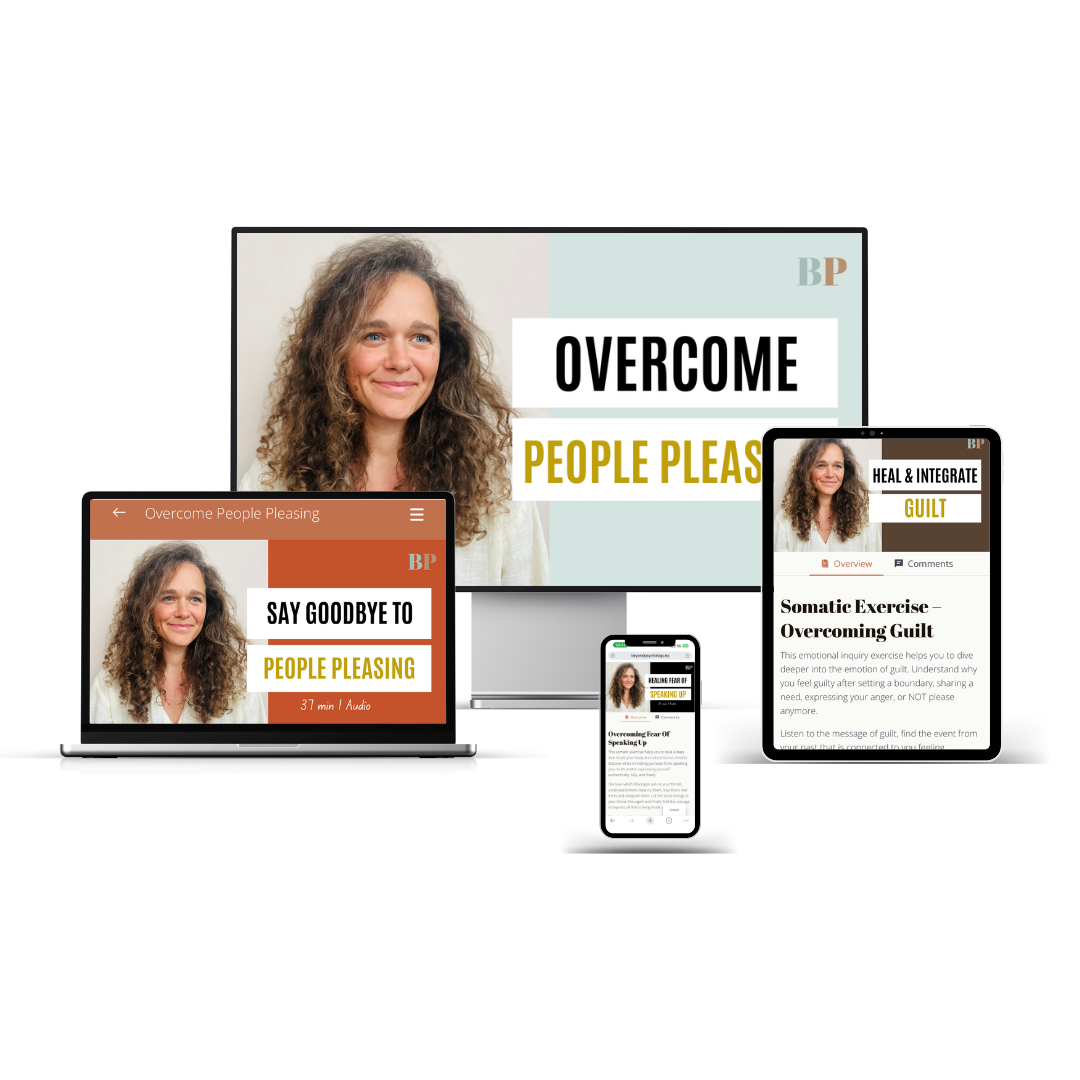
Say goodbye to the exhaustion of a body that carries everyone else’s comfort, and say hello to the person you were before you learned to please, with this complete somatic toolkit for people who are done shrinking to keep everyone else comfortable.
If you are someone who disappears in relationships and lose yourself trying to keep everyone else okay, OR someone whose voice goes quiet right when you need it most, and you find yourself saying “I know exactly why I do this, and I still cannot stop it” — this is for you.
real talk
It’s no secret: when you stop abandoning yourself, everything changes. Your voice comes back. Your confidence skyrockets. Your relationships deepen. Your body relaxes. You start living a life that actually feels like yours.
But I also get that stopping with people pleasing and abandoning yourself…?
Can feel impossible. Even when you know exactly what you are doing, because:
☽ “I understand the pattern completely, and I still collapse the moment someone is disappointed in me.”
☽ “I know I should set a limit, but the guilt is so overwhelming that I end up apologizing for having needs.”
☽ “I have done the therapy, read the books, and I still lose myself every time.”
And all this?
Has probably left you hollow, depleted, and performing a version of yourself that keeps everyone else comfortable while you quietly disappear.
And not achieving the relationships, the voice, the freedom, the life you know is possible.
Or even worse? Starting to wonder if this is just who you are.
But I am here to tell you, after years of doing this work with people in 1-on-1 sessions, and after going through this journey myself: once you stop abandoning yourself, you get your life back. And for the first time, you get to live and be loved as who you actually are.
Want to stop abandoning yourself and finally come home to who you actually are, PLUS break free from the pattern that has kept you small for years?
Then you just need to go directly to the place where the pattern actually lives: your body, not your mind.
And I am here to help!
I, Myrthe, have guided hundreds of people through this exact journey in 1-on-1 sessions, and have gone through it deeply myself…
…and I created Overcome People Pleasing: a complete somatic journey of 8 guided sessions following the same arc I take my 1-on-1 clients through.
It works because it goes where talk therapy often cannot: directly into the nervous system, where people pleasing is actually stored. Not to understand it. To meet it, feel it, and stay with yourself through it, until your body is ready to learn something new.
My guided audio sessions work in three movements: building somatic awareness, creating emotional tolerance, and returning to yourself. Not as concepts. As lived, practiced experiences in your own body.
And they are the KEY to finally stopping people pleasing at the level where it actually lives.
P.S. These are not watered-down versions of the real work. They are the real work, recorded. The same sessions, the same depth, the same process I use with clients who pay €155 per hour. Available to you, without a waiting list, without a schedule, without expiry.
Imagine how it will feel.
To go from where you are now, to what becomes possible when you stop spending all your energy on holding yourself down.
| Where you are | Where this goes |
|---|---|
| Your body already moving toward yes before you have thought anything. Agreeing before you have decided. | Feeling your real response. Staying with it for a moment. Choosing from there. |
| Not being able to voice your desires, share your opinions, speak your truth, before the self-editing begins. | Speaking. Not performing. Saying what you actually think, to the people who matter. |
| Being on guard all the time, hyperaware, because being fully yourself has never felt safe. | Feeling grounded. Present. No longer spending your energy managing everyone else's reactions. |
| Suppressing the parts of you that feel too much, want too much, take up too much space. | Unshaming those parts. Following your joy, your anger, your desire, your life force. Living. |
| Living a carefully managed version of your life. | Being a free human, emotionally, mentally, and physically. |
If that sounds good, and you feel a deep body yes, then…
you are invited to
Overcome People Pleasing
Say goodbye to abandoning yourself for everyone else, and say hello to the person you were before you learned to please, with this somatic toolkit for people who are done shrinking to keep everyone else comfortable.
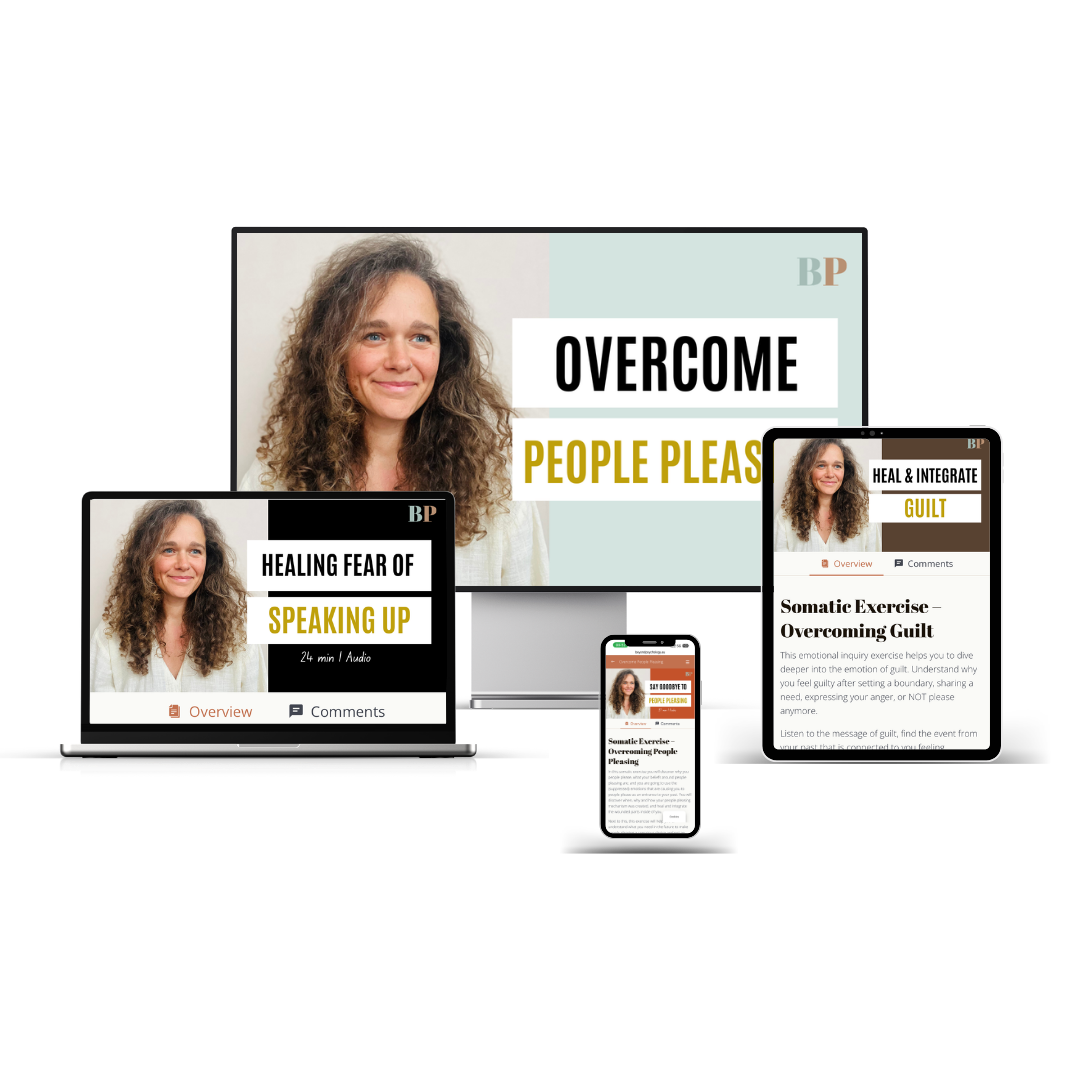
Here's what's inside.
A complete somatic journey of 8 sessions. The same arc I use in my 1-on-1 client work, recorded and offered directly to you. The same depth. The same process. In your own rhythm, without expiry.
Healing Fear of Speaking Up
So what you actually think and feel can finally come out, without your voice breaking or disappearing.Something is living inside you that wants to be expressed. This session takes you deep into your body and subconscious mind to discover what is holding it back. The blockages in your throat, the stuck energy, the suppressed truth. You will listen to them, feel them, and begin to integrate them. So the energy that has been frozen there can finally move again.
Healing and Integrating Guilt
So guilt stops being the reason you always end up last.Guilt is the immediate response to every boundary, every no, every moment you choose yourself. This session takes you into that guilt: where it comes from, what it is protecting, and what event from your past it is connected to. You will listen to its message, find its origin, and begin to heal and integrate it. So that guilt stops being the thing that pulls you back every time you dare to stay with yourself.
Overcoming Shame
So you can stop shrinking and start taking up the space that was always yours.Shame says: you are wrong, not what you did. And so you suppressed the parts of yourself that felt most dangerous to show. This session takes you all the way back to the first moment you decided to never feel shame again. To the parts of you that went quiet because of it. You will meet them, heal them, and begin to rediscover who you actually are beneath the suppression.
Stay - Overcome the Fear of Disappointing Others
So someone else's disappointment stops running your decisions.You know the panic when someone is disappointed in you. The urge to fix, explain, apologize, immediately. This session trains your nervous system to stay present instead of fleeing into pleasing. Not through willpower. Through direct, somatic practice, until your body learns something new: that disappointment can exist, and you can remain.
Healing Fear of Abandonment
So the fear of being left stops driving everything.Underneath most people pleasing is the same thing: don't leave. This session takes you into the unprocessed pain from the past that is driving that fear. You will discover where it comes from, feel it, express it, and begin to heal it. So love can flow again, and the dreams that are living inside of you have room to breathe.
Overcoming Fear of Setting Boundaries
So no becomes something your body can actually say.The difficulty with setting boundaries can almost always be traced back to early experiences, sometimes intergenerational. This session takes you there. To the root of what is blocking you, the suppressed emotions behind it, the hurt inner parts that learned to stay silent. You will discover, feel, heal, and integrate. And find the courage inside you to share your authentic self with the world.
Overcoming People Pleasing
So staying with yourself becomes stronger than the pull to abandon yourself again.In this session you will discover why you people please, what beliefs are keeping the pattern in place, and you will use the suppressed emotions underneath as an entrance to your past. You will discover when, why and how this mechanism was created, and heal the wounded parts inside of you. So that people pleasing becomes a conscious choice, and not an involuntary response anymore.
Transforming Anger
So the force underneath the pleasing can finally come back to you, as power instead of reactivity.For someone who has spent years pleasing, anger is the last emotion that becomes accessible. It lives underneath everything else. This session helps you to feel, release, and integrate the emotion in a healthy way. To investigate why your anger is here, receive the message underneath it, and learn how to regulate yourself, return to neutrality, and continue to mature emotionally. What returns to you is not reactivity. It is clarity, and a force that has been protecting you all along.
Your Yes and Your No
So you can feel what is actually true for you, before you have already decided to please.This is where most people start. A short, direct practice that brings you back to the felt sense of yes and no in your body, before the mind has already decided to please. Use it before a difficult conversation, as a daily practice, or whenever you need to come back to yourself.
Maybe you have already begun here. If so, you have already started the work. The toolkit is where it goes deeper.
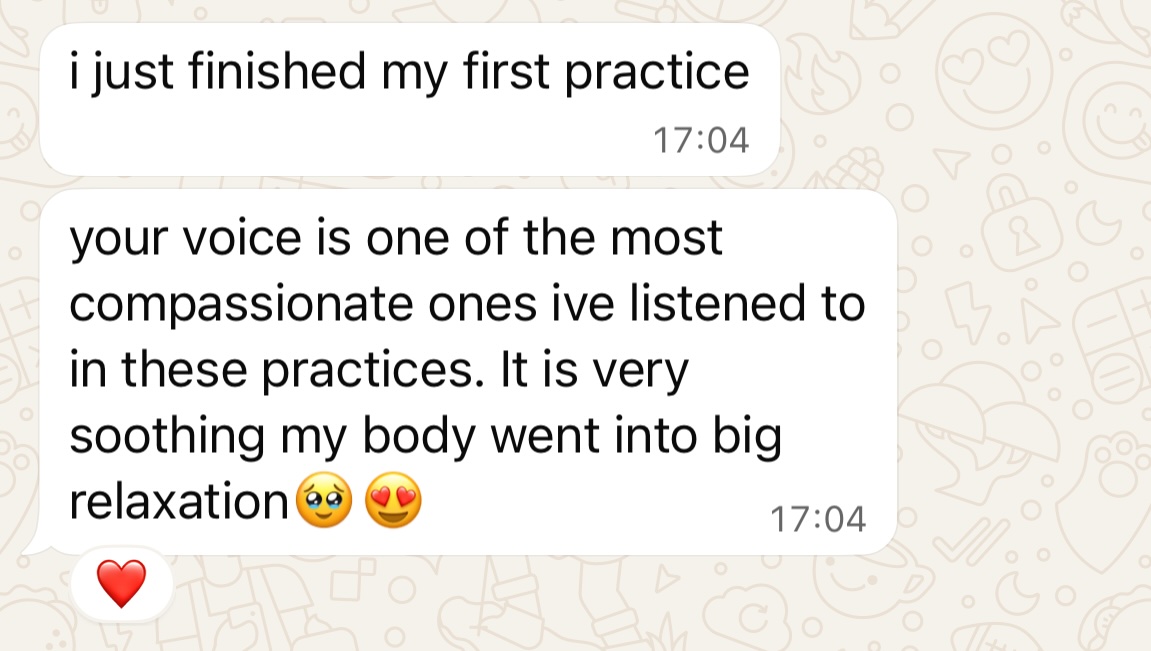
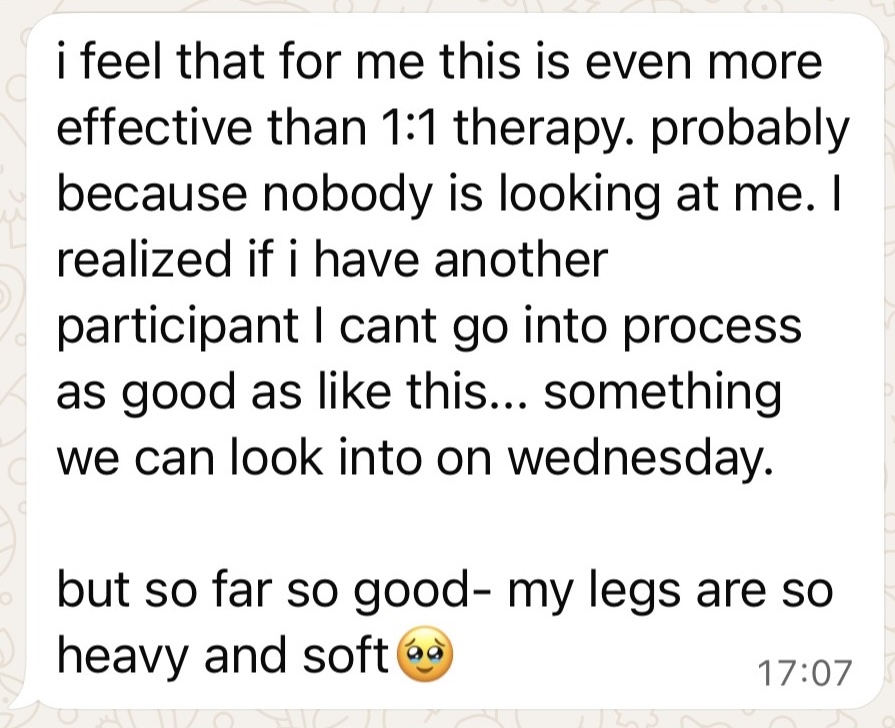
After the first sessions…

1-on-1 equivalent: €1.395
Value in shop: €216
Instant access | No expiry | In your own rhythm
What Other People Have to Say
“Oh gosh. I just did ‘Stay’. It is amazing. What I like is that it teaches you to stay with feelings of fear, panic, and anger, to really feel them. And to give the disappointment to the other person. To not carry everything on your shoulders. This is what I did in the past. I carried my emotions, plus the other side, plus I tried to soothe the situation. Super exhausting and stressful. I like how you stressed that people pleasing is not a flaw. It’s an intelligent mechanism that helped us survive. When you said that, I had less pity and anger towards myself. And even if it’s just audio, I felt supported, understood and safe. Thank you Myrthe, this was really special. And now I have a good practice I will come back to when I encounter a similar situation again.”
Špela Vehar, trauma-informed women’s health specialist
“The tools are so helpful, stepping into all the suppressed emotions from childhood together with my inner child and to be held. Freeing both of us. Noticing that anger, a scary emotion, is actually the most important thing to go towards, instead of running away from it. I feel it now as a warm support in my lower back. This is a very important step that I made.”
Meander
“I want to thank you. Today I expressed anger in a way I hardly ever do. It was just a loud response to a very usual bully attitude. I was surprised of myself and on purpose I let myself repeat louder. The person was confused but I didn’t explain. This is after a few days of doing one of the sessions. While I usually freeze and am not able to respond.”
Emilia
“I did one of the exercises today. It was really really special to me. There was a big kind of giant that was inside of me and that was holding me. With his huge hands he held my throat, my back and my womb for years and squeezed it. Then I asked it to come out. And he started to cry. Me too, I felt a lot of tears. We hugged for a long time. Then my body started to swirl. It was like a big vortex, going all different sides. All the places that were stuck before were soft and warm now. Since then I feel really relieved and have a big smile on my face. Thank you!”
Angelina
“It’s such a beautiful toolkit and I purchased it at the right time in my life. I am getting closer to myself more and more. I know now I can be myself, yes, and I really appreciate myself so much.”
Marga

So why am I the right person to guide you through this?
Hi, I’m Myrthe Glasbergen, MSc., psychologist and founder of Beyond Psychology.
I have spent over ten years doing this work on myself. Not as a side project. As the central work of my life. I know what it is to have been blamed, shamed, and punished for the parts of me that were most authentically mine. I know what it is to have learned, early and thoroughly, that choosing for yourself comes with consequences.
I am now the first free woman in my lineage. That is not a metaphor. It means: my own company, my own money, traveling, present to my own desires, able to say what I actually think and follow my joy and my anger and my life force wherever they lead. Living in a way I once could not have imagined. Not because I fixed something broken. Because I stopped suppressing the parts of me that were whole all along.
That journey is what led me to develop the emotion-focused guided audio work behind this toolkit. Sessions built from years of 1-on-1 work with clients, going again and again to the place where the pattern actually lives.
There is nothing wrong with you. You are not broken. You have been suppressing who you really are.
This toolkit is how you stop. I’d love to guide you through it.

Are you ready to come home to yourself, even if you have tried everything before and nothing has reached the place where the pattern actually lives?
"I used to think why healing and mindset trainings were not working for me. Now I feel so much more ready to observe my reactions and sit with my emotions. I have always had so many gifts and talents but always felt myself getting stuck. This feels like the un-stucking thing I've been needing. The last puzzle piece."
"This is the most comprehensive explanation of my anger and how to deal with it that I have come across. All the healing work I have done around childhood trauma has never addressed that anger. It has stifled me for a very long time. I think I'm finally ready to sit with myself and be open to the answers."
Do you have questions? Here are some answers.
I've read a lot about people pleasing. What makes this different?
I don't have much time.
I'm already in therapy. Is this for me?
What if this is too much for me right now?
What happens after I purchase?
Why is something this valuable only €97?
You've reached the end of this page.
Something in you is still here. Still considering.
The worst part of people pleasing is not the yes you didn't mean. It is what happens after. The moment when you realize, again, that you left yourself. That you chose someone else's comfort over your own truth.
That moment has a name. It is not weakness. It is not a character flaw. It is what happens when a body has learned, over many years, that staying with yourself is dangerous.
This toolkit will not fix that in one session. It will begin to teach your body something different. That you can be with the fear without disappearing. That your no is survivable. That disappointment can exist and you do not have to fix it. That you are allowed to remain.
That is not a small thing. And you deserve to find out what becomes possible when you stop holding yourself down.
This is your invitation. MyrtheRECAP: You get all of this instantly:
The complete somatic arc. The same depth as a 1-on-1 trajectory. In your own rhythm, without expiry.- Healing Fear of Speaking Up 24 min
- Healing and Integrating Guilt 29 min
- Overcoming Shame 32 min
- Stay, Overcoming the Fear of Disappointing Others 40 min
- Healing Fear of Abandonment 32 min
- Overcoming Fear of Setting Boundaries 47 min
- Overcoming People Pleasing 37 min
- Transforming Anger 30 min
- Your Yes and Your No bonus
1-on-1 equivalent: €1.395
Value in shop: €216
Instant access | No expiry | In your own rhythm
Lifetime access | No live calls | Beyond Psychology