

If there is one thing I have seen over and over again in my work with clients from all over the world, it is this. We all carry the same invisible wound. A deep sense of unworthiness, a quiet shame about who we truly are, and a constant fear that if our authentic self is fully seen, we will be rejected, abandoned or left behind. You might think this shame is just yours. Your fault. Your weakness. Your brokenness. It is not.
What you feel inside your body is not only about your childhood or your personal choices. It is the result of intergenerational trauma. A long line of unprocessed pain, oppression and emotional neglect that has been passed down through families, cultures and systems for centuries. It lives in our nervous system, our belief systems, our relationships, and it quietly shapes the way we see ourselves and the world.
To truly understand trauma healing, we have to look beyond the individual and see the bigger picture: how intergenerational trauma is present and often subconsciously shapes our lives, our choices, our relationships, and our ability to move freely and in peace through the world.
——– read on below the ad ———-
free guided somatic session
Your Yes & Your No
The 17-minute practice to stop abandoning yourself.
The very first step back to yourself. A free guided somatic session to come back to your body, your intuition, and the difference between a true yes and a conditioned one.
17 min ・ free audio
What Is Intergenerational Trauma Really
Intergenerational trauma is the pain that did not start with you, but lives in you. It is the emotional, relational and often physical impact of what your parents, grandparents and ancestors went through. Wars, poverty, colonialism, racism, sexism, religious shame, class inequality, forced migration, emotional neglect, unsafe marriages, silent suffering. Most of it never spoken about, never processed, never grieved.
Because they did not have the safety, language, resources or emotional tools for trauma healing, they did what humans always do in order to survive. They adapted. They suppressed. They coped. They disconnected from parts of themselves. And they raised children from that place.
Those children then grew up with emotionally immature, stressed, absent or overwhelmed parents, and had to adapt again. Little by little, generation after generation, a painful legacy was born. A legacy of self abandonment, shame, emotional numbness and a deep belief that we have to earn our right to exist.
That legacy lives in you.
How Oppressive Systems Create Intergenerational Trauma
Intergenerational trauma never happens in a vacuum. It is not just about difficult parents. It is about the world they had to survive in.
For centuries we have been living in a patriarchal, capitalist, colonial, heteronormative system that was designed by men for men. Especially white, straight, heteronormative men who lived in completely different times than we do now. Their worldview has been imposed on us through politics, education, religion, media and family structures.
From a young age we learn to trade our time and life force for money in order to simply exist, conform to narrow gender roles if we want safety, belonging and approval, see the nuclear heteronormative family as the only normal way of living, feel ashamed if we deviate from any of these norms.
The message is clear. If you want to belong, you must suppress your truth.
This is where intergenerational trauma and societal conditioning meet. Our parents did not just choose to be emotionally unavailable or stressed. Many of them were surviving under crushing expectations, financial pressure, gender roles and unprocessed trauma of their own. Their nervous system was already in survival mode before you were even born.
From Systems To Family. The Mother Wound And The Father Wound
When we zoom in from society to the family system, intergenerational trauma becomes very personal.
Our mothers grew up in a world that told them they were less than. Less rational. Less worthy. Less powerful. Their safety and survival often depended on men, marriage and compliance. They learned to be the good girl. To please. To caretake. To stay small. To suppress their anger, needs and boundaries.
Our fathers grew up in a world that told them they had to be strong, in control, productive, unemotional. They learned that vulnerability is dangerous, that feeling is weakness, and that their worth depends on status, work and authority. Many of them were emotionally cut off from themselves long before they became parents.
This is how the collective mother wound and father wound are created.
Mothers who are anxious, overburdened, depressed, people pleasing, emotionally unavailable or explosive. Fathers who are distant, harsh, absent, closed off or unreachable. Both shaped by systems that never cared for their emotional world.
And then you were born into that field.
——– read on below the ad ———-
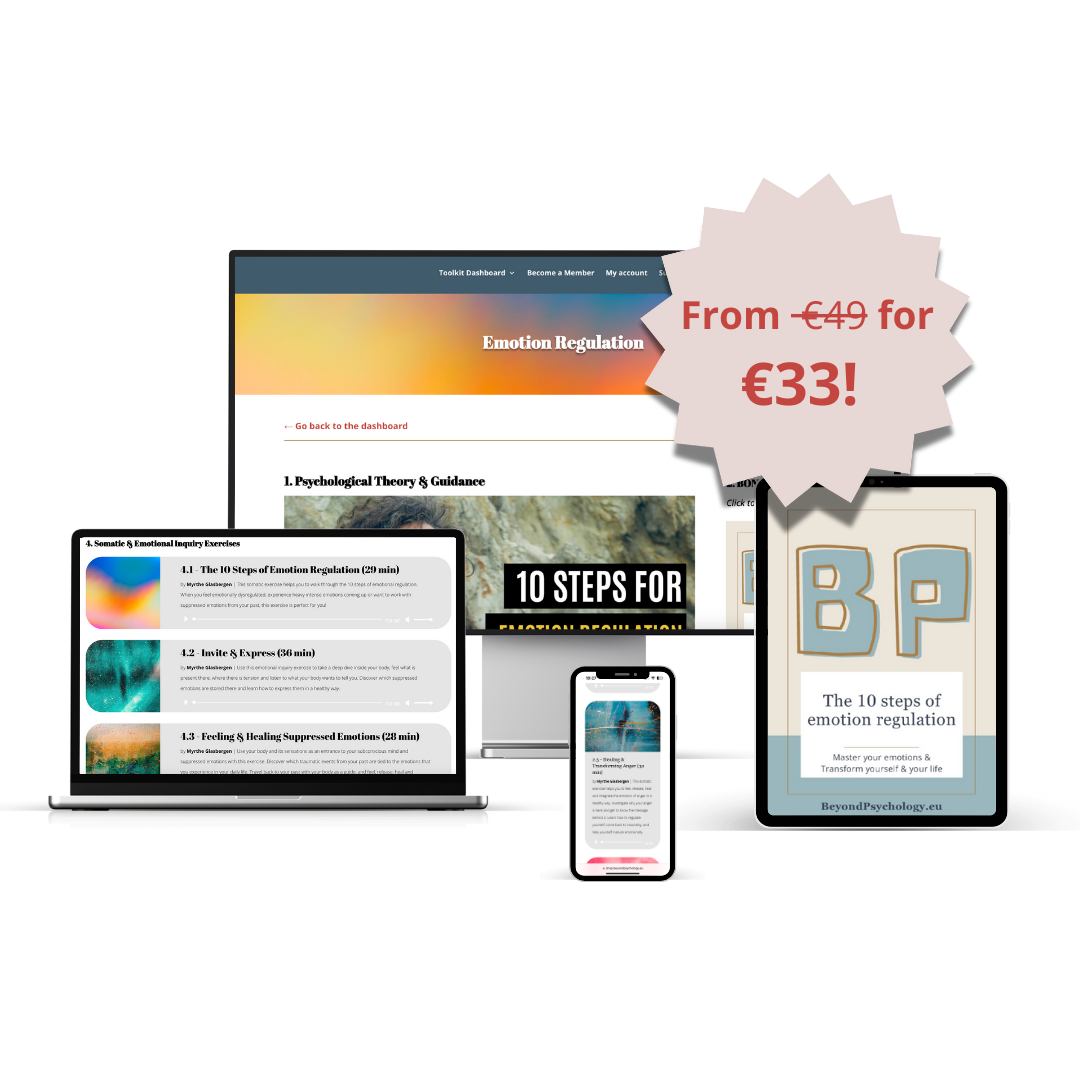
The Emotion Regulation Toolkit
Our Emotion Regulation Toolkit consists of 8 of our best healing tools that help you to heal from your past, release suppressed emotions, and transform yourself and your life.
Shop now for Only €49!
Relational Trauma: How Intergenerational Trauma Shows Up In Your Childhood
As a child you did not see patriarchy, capitalism or intergenerational trauma. You saw your parents. You felt their nervous system.
Maybe you had parents who worked all the time, were stressed, emotionally checked out or overwhelmed. Maybe you felt you were walking on eggshells. Maybe love felt conditional. Maybe your emotions were ignored, ridiculed or punished. Maybe there was addiction, conflict or silent distance in the house.
Even if there was no big event, the ongoing absence of emotional safety is in itself a form of trauma. Your body learned. It learned that your needs are too much, your emotions are dangerous, your truth is inconvenient, your boundaries push people away, love can be withdrawn at any moment.
To stay attached to your parents, you did what every child does. You chose attachment over authenticity. You suppressed your feelings, your aliveness, your boundaries, your intuition. You became the child you thought you had to be in order to be loved and safe. This is relational trauma. And it is one of the main ways intergenerational trauma continues to live through us.
The Shame Based Identity: Your Nervous System On Inherited Trauma
When your emotional and relational needs are not met, and you have no one to help you regulate and make sense of what is happening, you turn against yourself.
You create a story. A deficiency story.
I am difficult.
I am too much.
I am not enough.
I am bad.
I do not deserve love.
I am the problem.
This story helps you survive, because it keeps you attached to your parents. It is safer to believe that you are the problem than to face that the people you depend on cannot give you what you need.
Over time these stories harden into an identity. A shame based identity.
On the outside you might look successful, high functioning, caring, driven or independent. On the inside your nervous system is constantly scanning for danger. Are they upset with me. Did I do something wrong. Am I good enough yet.
This is how intergenerational trauma lives in your day to day life. In your relationships. In the way you overgive or shut down. In the way you people please or push people away. In anxiety, depression, burnout, numbness, chronic stress and self sabotage.
Not because you are broken, but because your body is still trying to keep you safe in a world that once was deeply unsafe.
——– read on below the ad ———-
Start Healing Intergenerational Trauma
-

Reparented – A Guided Somatic Session for Inner Child Reparenting
€ 27,00 -

No – A Guided Somatic Session to Stop People Pleasing
€ 27,00 -

Unshame – A Guided Somatic Session for Healing Shame
€ 27,00 -

Signal – A Guided Somatic Session for Healing Triggers
€ 27,00 -
Held – A Guided Somatic Session for Healing the Inner Child
€ 27,00 -
Mothered – A Guided Meditation for Healing the Mother Wound
€ 17,99
Intergenerational Trauma Is Not Your Fault. But It Is Your Responsibility
Here is the hard truth and the liberating truth at the same time.
Intergenerational trauma is not your fault. You did not choose this legacy. You did not choose the systems, the wars, the gender roles, the shame, the emotional immaturity that shaped your parents and grandparents.
But if it lives in you now, it has become your responsibility.
Not in a blaming way. In an empowering way.
Because you are the first one who has the awareness, the language and the tools for real trauma healing. You are the one who can say. It stops here. I will no longer abandon myself in order to belong. I will no longer pass this pain on to the next generation in the same unconscious way.
This is where trauma healing becomes an act of rebellion. And an act of love.
How To Begin Healing Intergenerational Trauma
Healing intergenerational trauma is not about fixing what is wrong with you. It is about understanding what happened, grieving what you never received, and slowly reclaiming the parts of you that had to go underground.
This process often includes learning to regulate your nervous system so your body no longer lives in permanent survival mode. This means getting curious about your family history, the mother wound, the father wound and the systems your parents grew up in. It means naming your deficiency stories and questioning whether they are actually true, meeting your younger parts with compassion instead of judgment, and practicing new ways of relating that are based on boundaries, honesty and emotional safety instead of fear and self abandonment.
You do not have to do this alone. In fact, you were never meant to do this alone. Trauma is created in relationship and so is healing.
Beyond Psychology And Your Psychologist In Your Pocket
At Beyond Psychology we look at trauma healing through this wider lens. We do not just ask what is wrong with you. We ask what happened to you, what happened to your parents, what happened to your ancestors, and what kind of world you were all trying to survive in.
Our resources are here to support you on that journey. If you want ongoing support, guidance and tools, the Beyond Psychology Membership gives you access to our trauma informed tool library, Ask A Therapist videos, the healing journey roadmap and a supportive community — like having a psychologist in your pocket every single day. Become a member here.
If you are reading this and you recognize yourself, know this. You are not too broken. You are not the problem. You are the turning point. Intergenerational trauma may live in your body. But you also carry the possibility for intergenerational healing.
Related reading: Inner Child Healing / Shame / Stored Anger
Go Deeper
Ready for a next step? Explore our paid tools & programs.


Related Blogs

How to Heal the Fear of Disappointing Others
You probably know the moment. Someone is disappointed in you. They do not shout, and they do not reject you outright. Maybe they sigh. Maybe they pull back slightly. Maybe they simply say they expected something else. And inside, everything happens at once. Your chest...

Healing The Mother Wound: What is it & How to do it?
The relationship with your mother is the first place where your nervous system learns what it means to be in relationship at all. Long before you can think, speak, or understand your environment, your body is already forming conclusions about safety, presence, and...

This Is Why Women Keep Choosing The Wrong Man
Most women already know. They know he is not the right one. They know this is not the life they actually want. Somewhere beneath the performance of contentment, they know they have accepted second best. And they stay anyway. Not because they are foolish, and not...

What a wise loving article!
Thank you Nanny!