

Many people who struggle with low self-worth believe something is fundamentally wrong with them. They assume they lack confidence, resilience, or the right mindset. As a result, they try to think more positively, practice self-love, or repeat affirmations in the hope that the feeling of not being enough will finally disappear.
Yet for many, nothing truly changes.
The same patterns return. Self-doubt resurfaces. Shame creeps back in. And the sense of having to prove oneself never fully settles.
If this sounds familiar, it may help to understand one essential thing: low self-worth is not a mindset problem. It is not something you think your way out of.
Low self-worth develops through the nervous system. It forms through lived experience, especially in relationships where emotional safety was inconsistent or missing.
At Beyond Psychology, we approach self-worth not as a personal failure, but as the outcome of emotional conditioning, relational wounds, and unmet developmental needs.
——— read on below the ad ———
free guided somatic session
Your Yes & Your No
The 17-minute practice to stop abandoning yourself.
The very first step back to yourself. A free guided somatic session to come back to your body, your intuition, and the difference between a true yes and a conditioned one.
17 min ・ free audio
Why Self-Worth Does Not Change Through Positive Thinking
From a trauma-informed perspective, self-worth does not originate in belief. It originates in felt safety.
When you grow up in an environment where emotions are ignored, dismissed, punished, or overwhelming, your system learns very early which parts of you are welcome and which are not. Needs may feel like a burden. Anger may feel dangerous. Vulnerability may feel risky. Boundaries may threaten connection.
To stay connected, you adapt.
These adaptations often show up later as people pleasing, perfectionism, self-silencing, emotional withdrawal, or over-responsibility. Although they may look like personality traits, they are not. They are survival strategies shaped by relational experience.
Over time, these strategies create an internal split. Certain parts of you remain expressed and functional, while others go underground. This internal disconnection, not a negative belief, forms the foundation of low self-worth.
You do not feel unworthy because you believe you are. You feel unworthy because parts of you learned they were safer when hidden.
What Trauma-Informed Healing Actually Focuses On
Trauma-informed healing does not begin with behavior change or self-improvement. Instead, it starts with understanding how and why adaptation happened.
Rather than asking, “How do I fix myself?”, the question becomes, “What did I learn to suppress in order to belong?”
When emotional expression repeatedly led to rejection, instability, or emotional distance, the nervous system responded intelligently. It reduced expression. It lowered visibility. It learned to prioritize connection over authenticity.
Those suppressed parts did not disappear. They remained present in the body as frozen emotional responses, held outside of awareness yet still influencing how safe life feels.
This explains why insight alone rarely heals self-worth. You may understand your childhood dynamics clearly and still feel unable to change how your body reacts. Your system does not need convincing. It needs integration.
Self-Worth Healing and Frozen Emotional Parts
Self-worth difficulties often indicate that certain emotional experiences were never allowed to fully complete. Grief, anger, fear, or need may have felt too much for your early environment to hold.
As a result, these emotions froze.
You may have learned that being yourself was inconvenient, overwhelming, or disruptive. Perhaps you felt too sensitive, too intense, or too dependent. Over time, disconnecting from those parts became a way to stay safe.
Self-worth healing therefore does not mean building confidence or repeating affirmations. It means re-establishing contact with what had to go quiet.
When these frozen parts begin to receive attention, presence, and emotional permission, the system no longer needs to protect itself through self-suppression. The feeling of not being enough starts to loosen, not because you changed your thinking, but because your body no longer lives in constant self-correction.
——— read on below the ad ———
Heal Your Self-Worth: Shop Trauma-informed Tools
-

Stay – A Guided Somatic Session for the Fear of Disappointing Others
€ 27,00 -

Imperfect – A Guided Parts Work Session for Overcoming Perfectionism
€ 27,00 -

Worthy – A Guided Somatic Session for the Wound of Unworthiness
€ 27,00 -

Reparented – A Guided Somatic Session for Inner Child Reparenting
€ 27,00 -
Sale!

Unshame Yourself: Book + Workbook
Original price was: € 28,00.€ 22,99Current price is: € 22,99. -
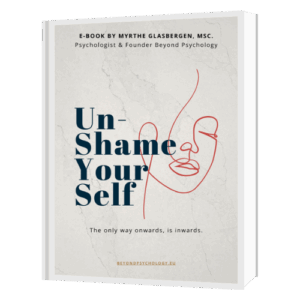
The Unshame Yourself E-book: A Book on Healing Shame and Unworthiness
€ 17,99 -

No – A Guided Somatic Session to Stop People Pleasing
€ 27,00 -

Move – Overcoming Procrastination: Guided Parts Work Session
€ 27,00
How Trauma-informed Healing Restores Self-Worth
Trauma-informed healing focuses on restoring internal safety rather than forcing change. Instead of pushing yourself to behave differently, you learn to stop abandoning yourself when emotional discomfort arises.
This process often looks subtle.
You allow sadness without collapsing into shame.
You feel anger without suppressing or acting it out.
You notice a need without immediately dismissing it.
As these experiences repeat, the nervous system learns something new: emotional activation no longer leads to abandonment. Gradually, the internal alarm quiets.
Self-worth then begins to rebuild naturally. Not as inflated confidence, but as steadiness. You start to trust your own signals. Boundaries become clearer. Rest feels permitted. Presence replaces performance.
Self-Worth Healing Is Not Self-Improvement
One of the most persistent misconceptions around self-worth is the idea that healing requires becoming better, stronger, or more healed. Trauma-informed work takes a different path. It does not add something to you. It removes what taught you to disconnect from yourself in the first place.
Self-worth does not emerge through fixing yourself. It emerges when you stop leaving yourself behind.
Ready to Heal Your Self-Worth?
At Beyond Psychology, we offer trauma-informed tools, somatic exercises, and guided reflections designed as a psychologist in your pocket. These resources support self-worth healing by helping you reconnect with suppressed emotions and wounded parts, step by step.
You can explore these tools via the Beyond Psychology Webshop, or inside the Beyond Psychology Membership.
Go Deeper
Ready for a next step? Explore our paid tools & programs.


Related Blogs

The Truth About Why You Feel Guilty For Choosing Yourself
Guilt shows up the moment you start to change. It shows up when you finally set the boundary, when you stop answering every call, when you choose the version of your life that actually feels like yours instead of the one everyone around you has come to expect. Feeling...

The Truth About Why You Can’t Orgasm With A Partner
Alone, you know exactly what to do. Your body finds its way there without effort, without negotiation, without anything standing in between you and what you feel. With a partner, something closes that was open only hours before. You get close and it turns back on...

The Truth About The Male Loneliness Epidemic: Why Men Feel Lonely (It’s Not What You Think)
Are Men Okay? This past week I caught myself asking the question out loud more than once. Are men okay? I mean that seriously, not rhetorically. Toxic male behavior keeps surfacing in the news, in workplaces, in the darkest corners of the internet where men gather to...
